

_____
AMETHYST WITH AGATE PART POLISHED CLUSTER
Artigas, Uruguay
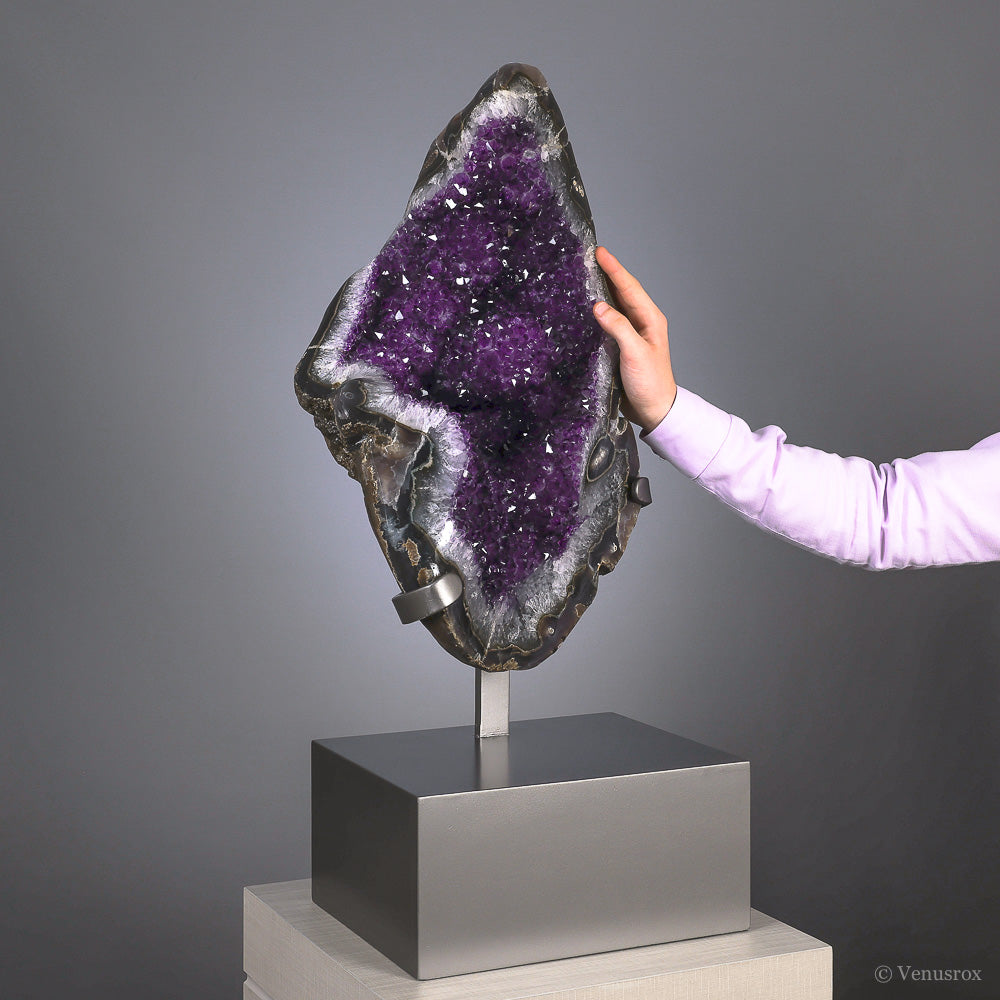
77.5cm x 35.0cm x 26.0cm (30.5in x 13.8in x 10.2in)
Available for Private Acquisition
Enquiries handled privately via WhatsApp or email
_____
Choose options
Uruguay's Artigas department has long been recognised among mineralogists as the source of the world's most intensely coloured amethyst — specimens whose depth of violet rivals and frequently surpasses those found anywhere else on Earth. This distinction is not incidental but geological: the amethyst-bearing basalts of Uruguay's Arapey Formation, part of the vast Paraná flood basalt province, provided uniquely favourable conditions for the incorporation of iron and subsequent natural irradiation that together produce the coveted, deeply saturated hues for which Uruguayan material is celebrated.
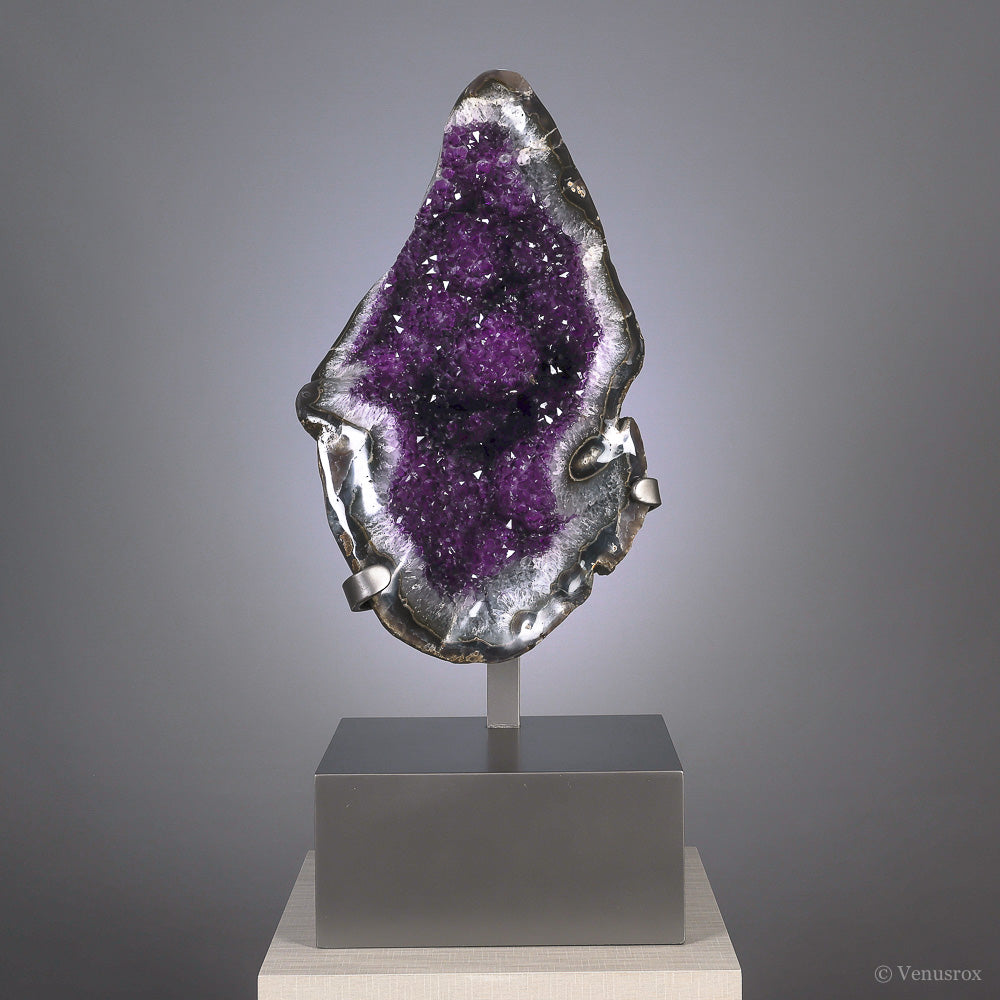
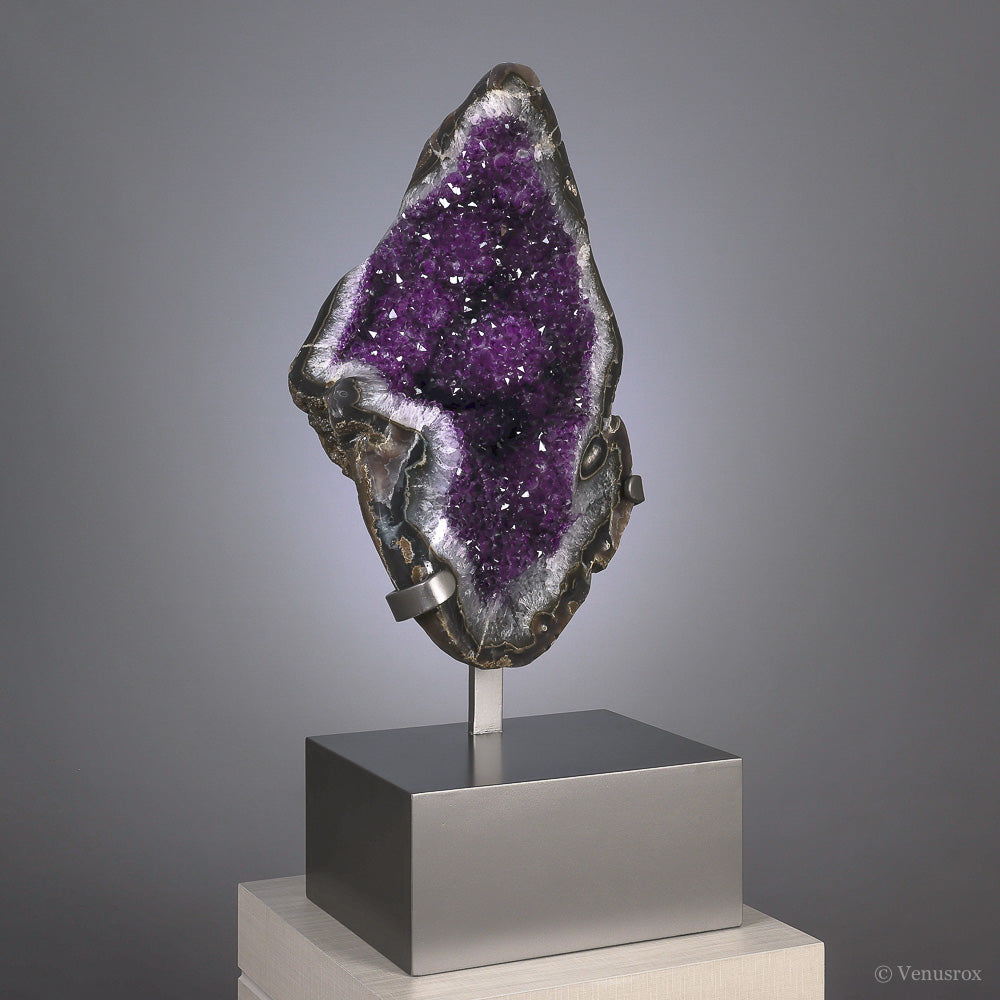
This part-polished cluster is a commanding example of that provenance. The elongated, flame-like silhouette of the specimen opens to reveal a dense interior of well-terminated amethyst crystals displaying a rich, consistently saturated violet that deepens toward the heart of the cavity. Individual terminations are sharply faceted and highly reflective, catching and fragmenting light across their surfaces to produce a play of brilliance that shifts with the viewing angle, a quality sometimes referred to among collectors as the "grape jelly" effect, prized precisely for its rarity.
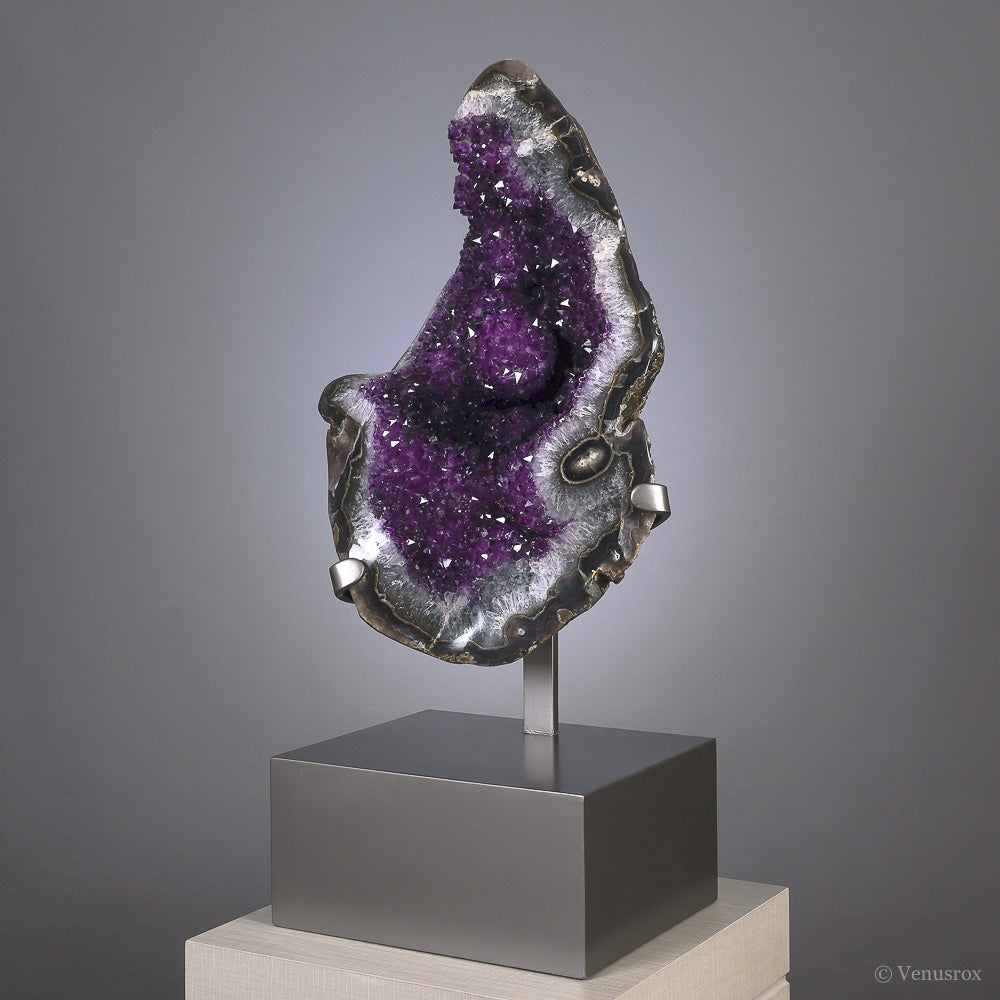
Where the outer surface has been selectively polished, the concentric mineral architecture of the geode is laid bare: a progression from the rough volcanic basalt rind through banded agate, itself a microcrystalline variety of quartz deposited in rhythmic layers, into a transitional zone of frosted white quartz before yielding to the crystalline amethyst interior. Each band represents a distinct episode of silica-rich fluid deposition into the original volcanic gas cavity, a process unfolding over millions of years within the cooling basalt. The unpolished portions of the exterior preserve the raw, weathered surface of the host rock, offering a tactile contrast to the luminous gemstone within.
AMETHYST
Amethyst is believed to create an energetic barrier that deflects harmful influences and negative energies from your surroundings. This protective quality manifests as a sensation of being enveloped in a bubble light, fostering a sense of safety and spiritual sanctuary.
Amethyst strengthens your inner resolve and fortitude, empowering you to face challenges with greater confidence. Its clarifying properties help dissolve mental fog and confusion, promoting clear thinking and enhanced focus.
As a catalyst for spiritual development, Amethyst opens pathways to higher consciousness and deeper understanding, facilitating personal transformation and expanded awareness of metaphysical realms.
AGATE
Agate in all its colours is a strong grounding stone, encouraging stability, strength, and personal power.
It assists one to remain balanced and grounded in all situations, allowing one to assess situations without one’s emotions getting in the way and encouraging one to be in one’s power to make the right decisions.
It also helps one to awaken and discover one’s inherent natural talents which everyone has been gifted with and to believe in oneself.
Agate is a powerful ally to have as one navigates one’s journey through this lifetime.
Description
Uruguay's Artigas department has long been recognised among mineralogists as the source of the world's most intensely coloured amethyst — specimens whose depth of violet rivals and frequently surpasses those found anywhere else on Earth. This distinction is not incidental but geological: the amethyst-bearing basalts of Uruguay's Arapey Formation, part of the vast Paraná flood basalt province, provided uniquely favourable conditions for the incorporation of iron and subsequent natural irradiation that together produce the coveted, deeply saturated hues for which Uruguayan material is celebrated.
This part-polished cluster is a commanding example of that provenance. The elongated, flame-like silhouette of the specimen opens to reveal a dense interior of well-terminated amethyst crystals displaying a rich, consistently saturated violet that deepens toward the heart of the cavity. Individual terminations are sharply faceted and highly reflective, catching and fragmenting light across their surfaces to produce a play of brilliance that shifts with the viewing angle, a quality sometimes referred to among collectors as the "grape jelly" effect, prized precisely for its rarity.
Where the outer surface has been selectively polished, the concentric mineral architecture of the geode is laid bare: a progression from the rough volcanic basalt rind through banded agate, itself a microcrystalline variety of quartz deposited in rhythmic layers, into a transitional zone of frosted white quartz before yielding to the crystalline amethyst interior. Each band represents a distinct episode of silica-rich fluid deposition into the original volcanic gas cavity, a process unfolding over millions of years within the cooling basalt. The unpolished portions of the exterior preserve the raw, weathered surface of the host rock, offering a tactile contrast to the luminous gemstone within.
Metaphysical
AMETHYST
Amethyst is believed to create an energetic barrier that deflects harmful influences and negative energies from your surroundings. This protective quality manifests as a sensation of being enveloped in a bubble light, fostering a sense of safety and spiritual sanctuary.
Amethyst strengthens your inner resolve and fortitude, empowering you to face challenges with greater confidence. Its clarifying properties help dissolve mental fog and confusion, promoting clear thinking and enhanced focus.
As a catalyst for spiritual development, Amethyst opens pathways to higher consciousness and deeper understanding, facilitating personal transformation and expanded awareness of metaphysical realms.
AGATE
Agate in all its colours is a strong grounding stone, encouraging stability, strength, and personal power.
It assists one to remain balanced and grounded in all situations, allowing one to assess situations without one’s emotions getting in the way and encouraging one to be in one’s power to make the right decisions.
It also helps one to awaken and discover one’s inherent natural talents which everyone has been gifted with and to believe in oneself.
Agate is a powerful ally to have as one navigates one’s journey through this lifetime.