
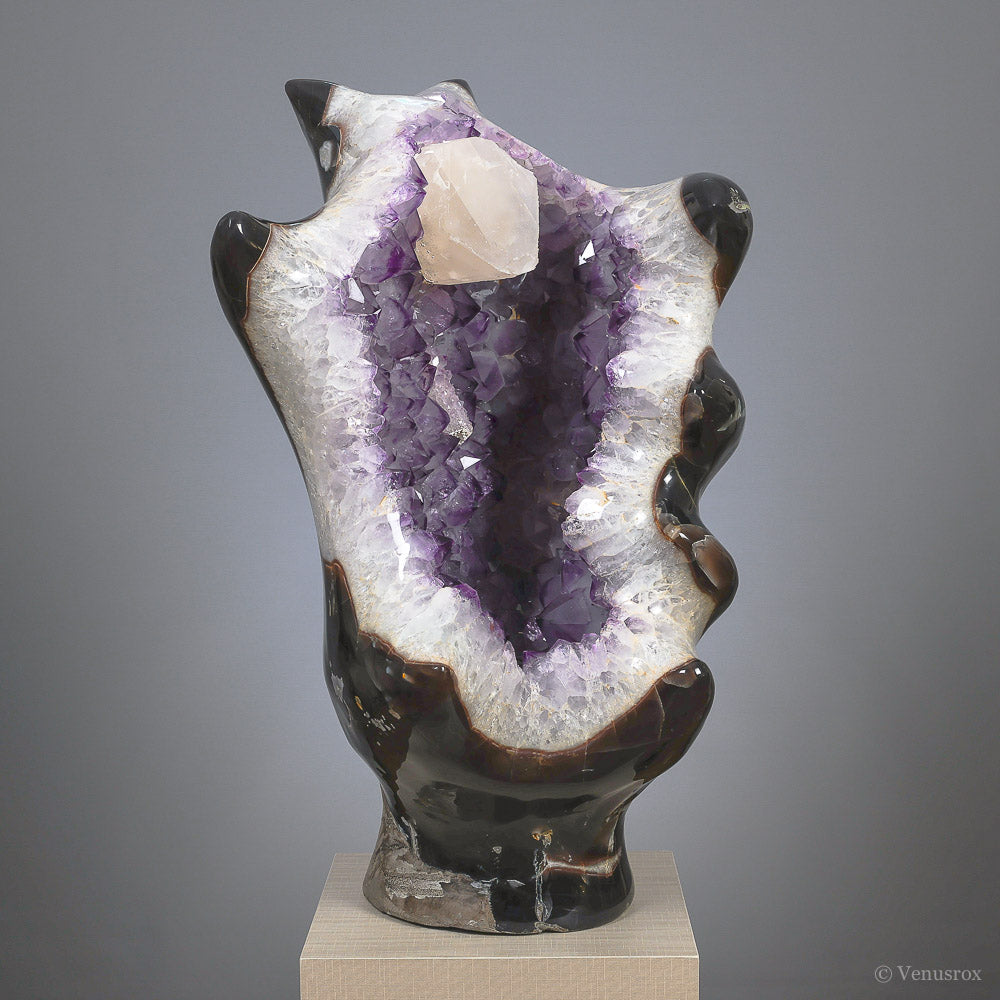
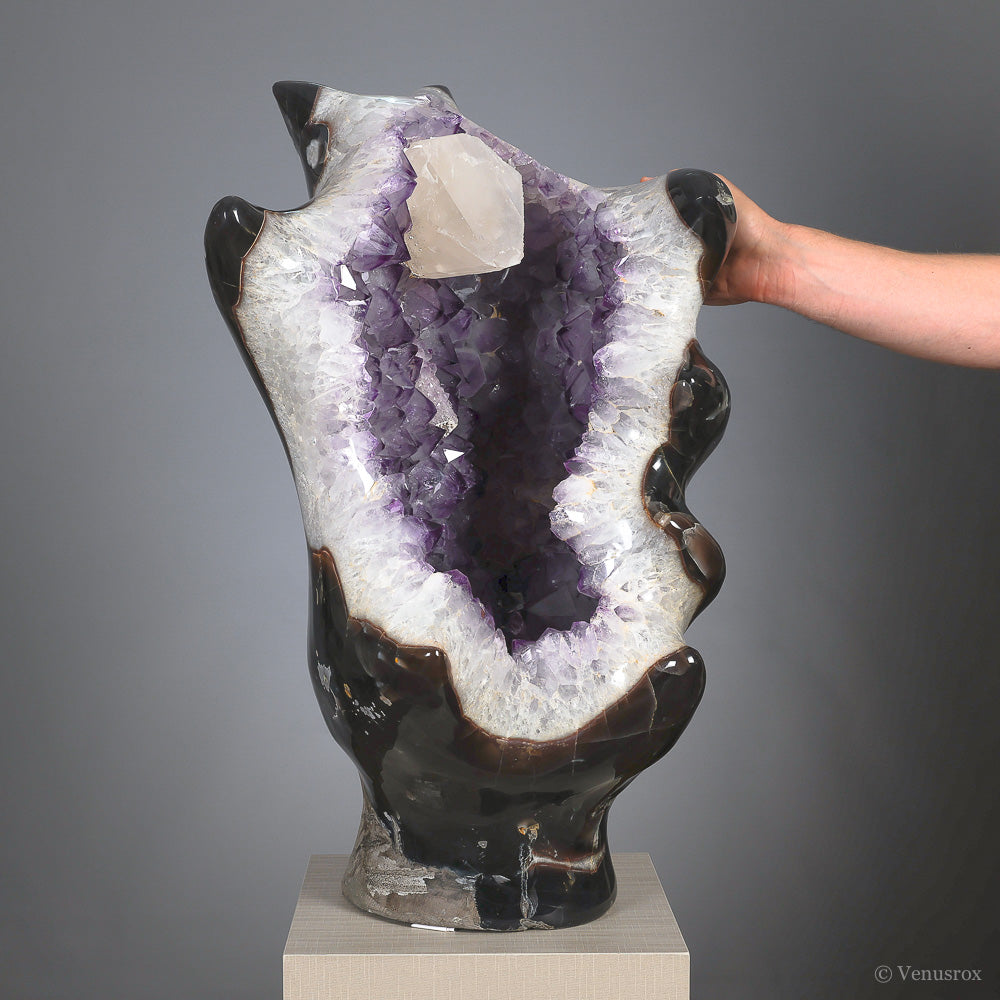
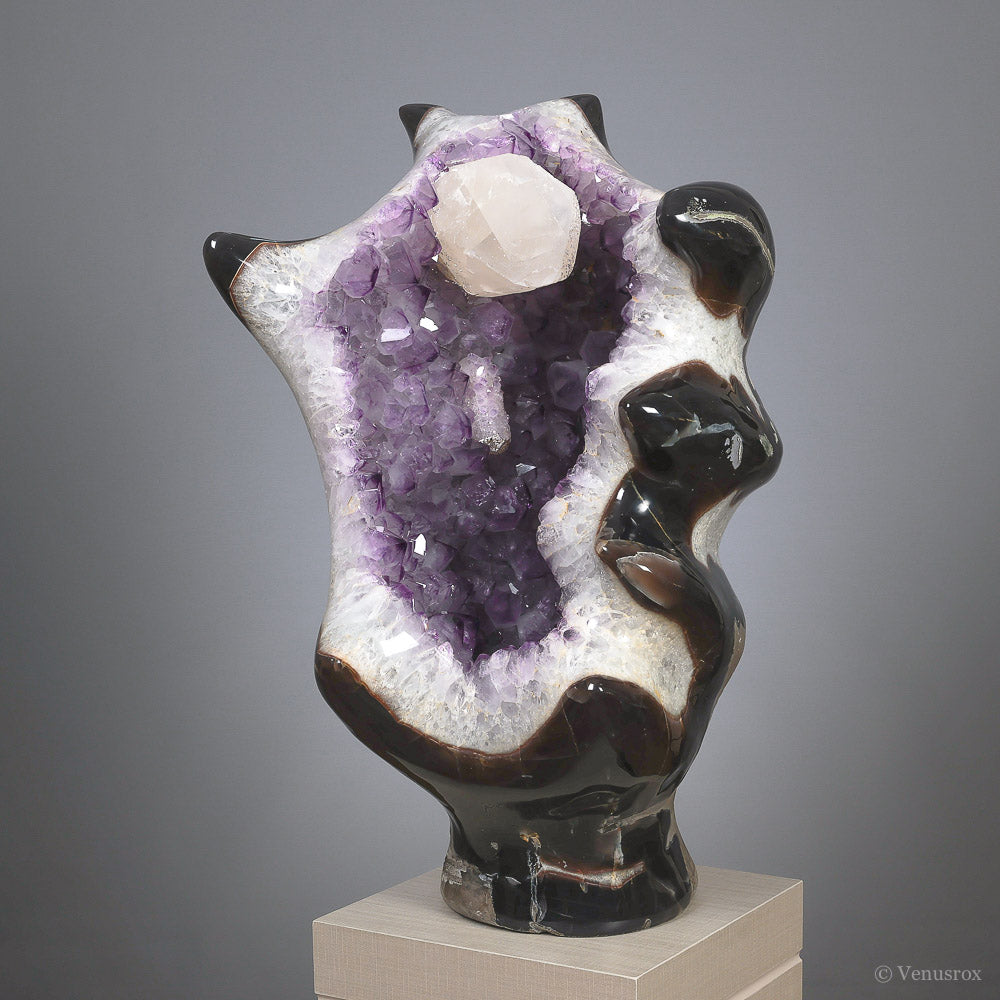
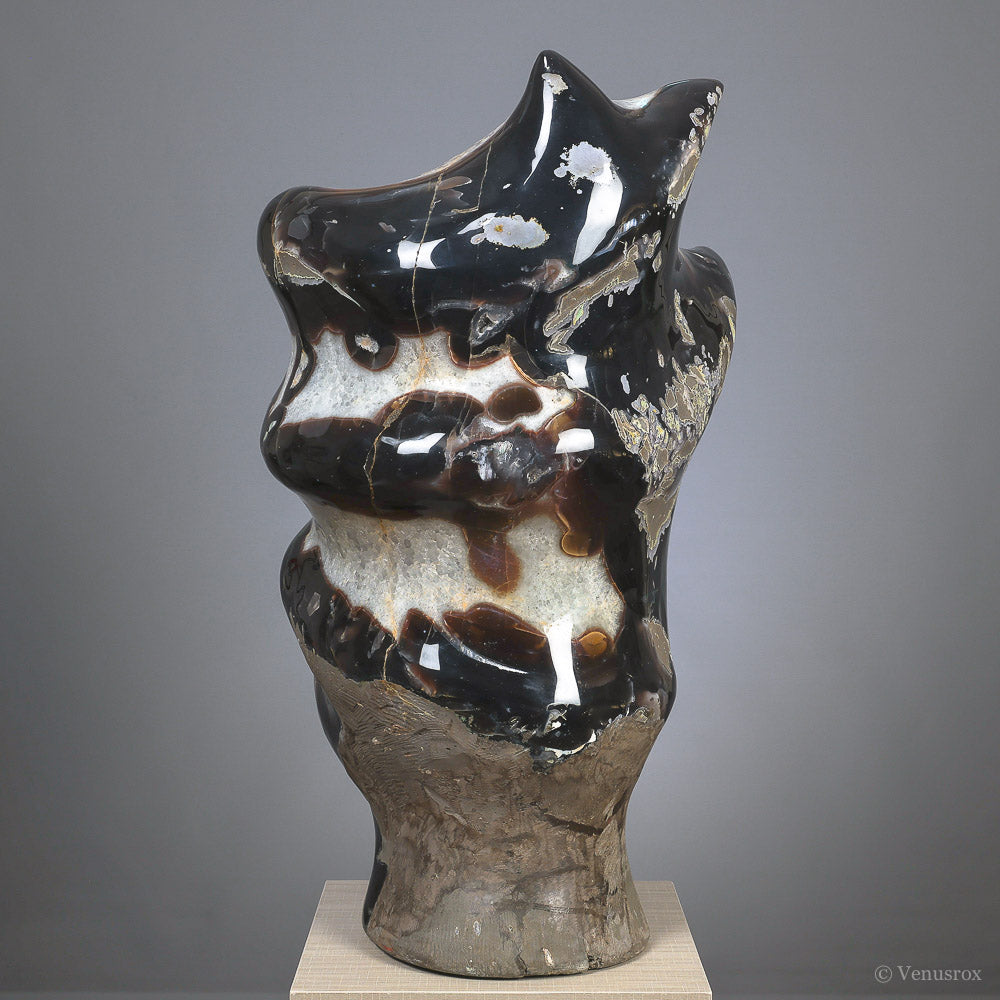
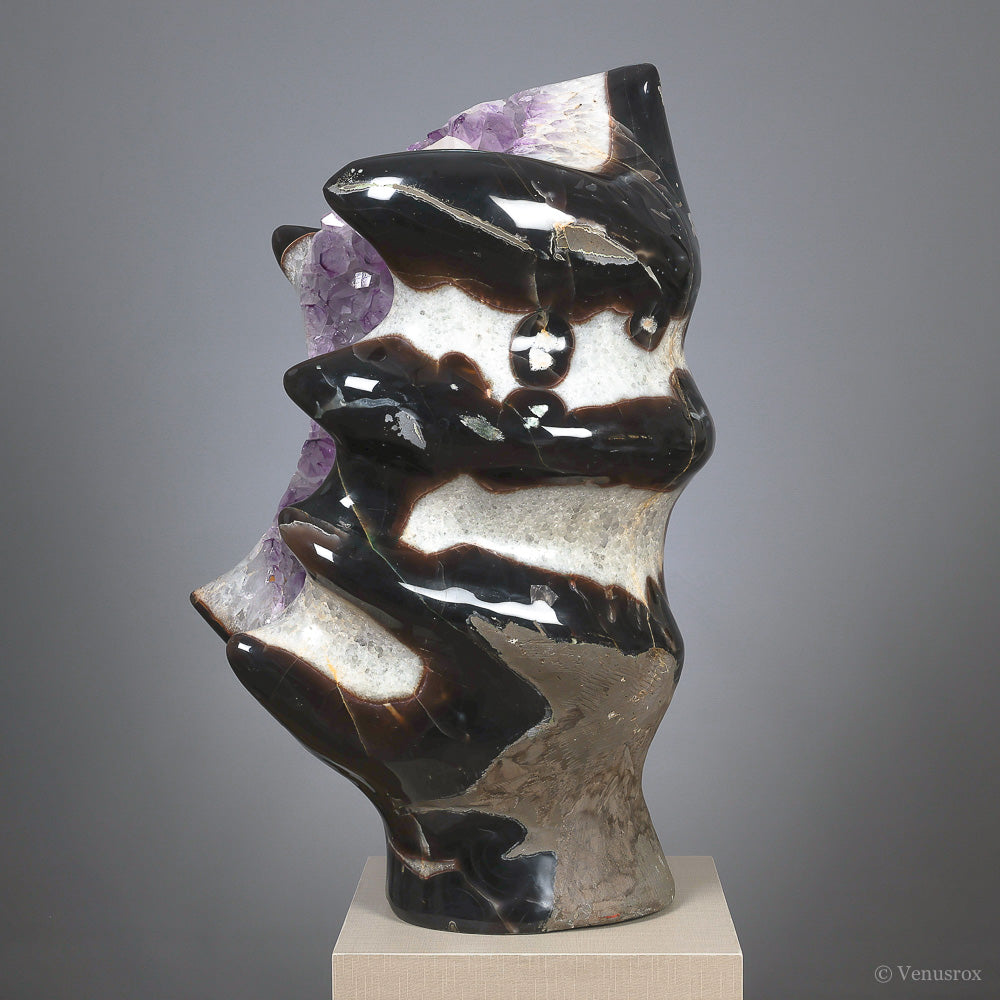
AMETHYST WITH QUARTZ, AGATE & CALCITE FREEFORM
ORIGIN:
Product Details
- CRYSTAL/MINERAL
- AMETHYST
- location
- Brazil
- SKU
- 052107
- DIMENSIONS
- 66cm x 41cm x 37cm (26.0in x 16.1in x 14.6in)
- GEOLOGICAL FORMATION
- AMETHYST
Amethyst is a variety of quartz that forms in volcanic rock cavities and geodes through the slow crystallization of silica-rich solutions. Its distinctive purple coloration results from trace iron impurities and natural radiation exposure during formation, typically occurring over millions of years.
The crystal structure follows the standard hexagonal pattern of quartz, with color intensity ranging from pale lavender to deep violet depending on iron content and radiation levels. Primary deposits are found in Brazil's basaltic flows, Uruguay's agate-lined cavities, and various locations worldwide where volcanic activity created suitable formation environments.
Amethyst crystals develop as druzy clusters or individual points within host rock, often displaying zoning patterns that reflect changing chemical conditions during growth. The gemstone ranks 7 on the Mohs hardness scale, making it durable while retaining the optical clarity characteristic of well-formed quartz specimens.
Formation requires specific temperature and pressure conditions, typically occurring at depths where hydrothermal solutions can circulate through fractured volcanic rock over extended geological timeframes.
Hardness: 7 on the Mohs scale | Crystal System: Hexagonal
AGATE
Agate forms in cavities within volcanic and sedimentary rocks through the slow precipitation of silica-rich groundwater over millions of years. This cryptocrystalline variety of quartz displays characteristic concentric banding created by successive layers of mineral deposition, with each band representing a distinct phase of formation.
The stone exhibits translucency to opacity with a vitreous to waxy luster. Color variations result from trace mineral inclusions—iron oxides produce reds and yellows, manganese creates purples and pinks, while chromium generates greens. The distinctive banded patterns form as silica gel fills rock cavities from the outside inward, creating the diagnostic layered structure.
Agate has been utilized since the Neolithic period, with significant historical deposits in the Nahe River valley of Germany giving the mineral its name. The stone's durability stems from its 6.5-7 Mohs hardness rating and fine-grained structure, allowing for detailed carving and high polish retention.
Hardness: 6.5-7 on the Mohs scale | Crystal System: Hexagonal | Composition: SiO₂ (Silicon dioxide)
CALCITE
Calcite is a calcium carbonate mineral that forms in sedimentary, metamorphic, and hydrothermal environments worldwide. The crystal exhibits trigonal symmetry and displays notable optical properties, including double refraction—a phenomenon where light passing through the crystal splits into two rays, creating duplicate images.
The mineral crystallizes in numerous forms, from simple rhombohedrons to complex scalenohedral shapes. Specimens range from completely transparent (particularly the variety known as Iceland spar) to translucent or opaque, with coloration influenced by trace impurities that can produce yellow, orange, blue, or green hues.
Calcite cleaves perfectly along three planes, creating smooth, reflective surfaces that intersect at characteristic angles. This cleavage property, combined with its relatively low hardness of 3 on the Mohs scale, makes it easily identifiable in the field. The mineral effervesces readily in dilute hydrochloric acid, a diagnostic test geologists use for identification.
Found in limestone caves, marble quarries, and hydrothermal veins, calcite represents one of the most common carbonate minerals on Earth's surface.
Hardness: 3 | Crystal System: Trigonal | Composition: CaCO₃
CLEAR QUARTZ
Clear Quartz is silicon dioxide (SiO₂) and ranks as one of the most abundant minerals in the Earth's continental crust. It crystallizes in the hexagonal system, typically forming six-sided prismatic crystals terminated by pyramidal faces, though massive and granular varieties are equally common.
The mineral exhibits a hardness of 7 on the Mohs scale and displays no cleavage, instead breaking with a distinctive conchoidal fracture that produces sharp, curved surfaces. Clear Quartz is colorless and transparent.
Clear Quartz demonstrates piezoelectric properties, generating electrical charge under mechanical stress—a characteristic that makes it valuable in electronic applications. The mineral also shows strong resistance to chemical weathering, persisting in sedimentary environments long after other minerals have decomposed.
Found in igneous rocks like granite and rhyolite, metamorphic rocks such as quartzite and gneiss, and as hydrothermal vein deposits, quartz occurs in virtually every geological environment. Its durability and chemical stability make it a primary component of sandstone and a dominant constituent of many soils.
Hardness: 7 | Crystal System: Hexagonal | Composition: SiO₂
Price on Application
Choose options
AMETHYST WITH QUARTZ, AGATE & CALCITE FREEFORM
Sale priceAED 117,600.00