
_____
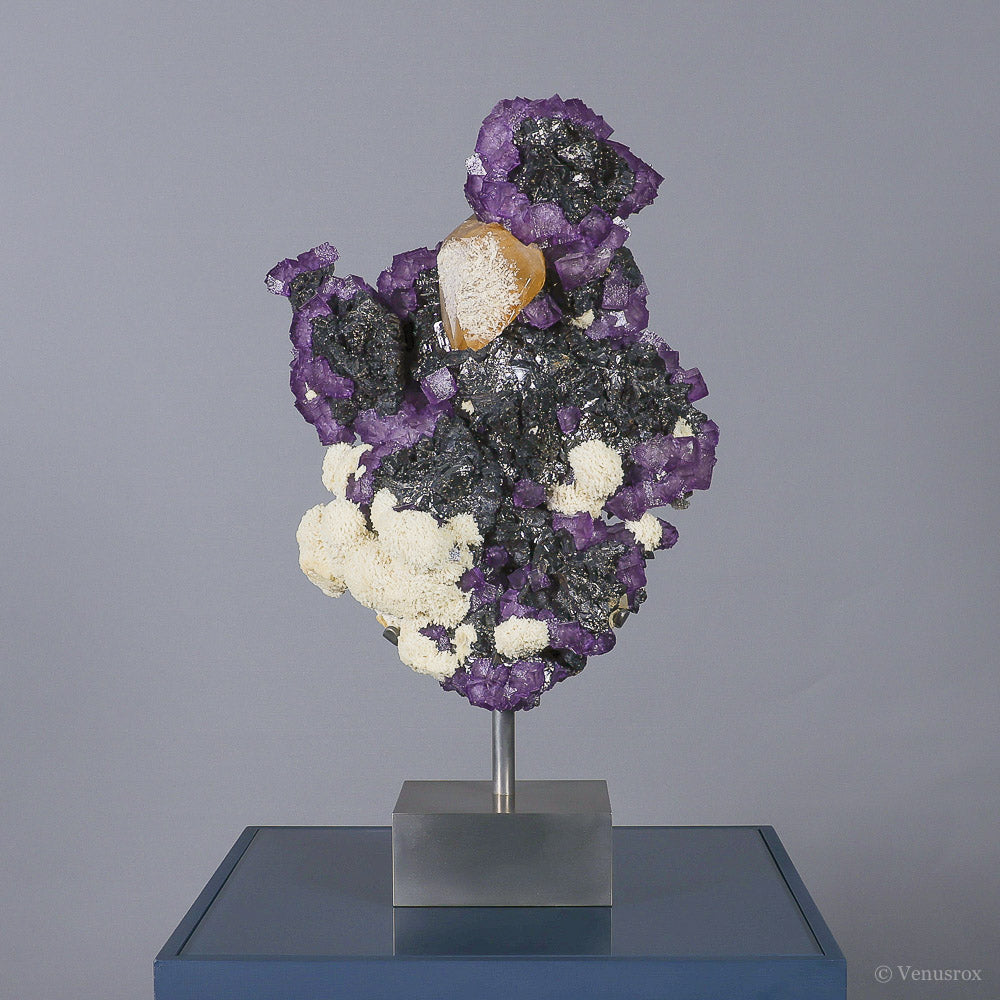
FLUORITE WITH CALCITE (STELLAR BEAM) & BARITE ON SPHALERITE NATURAL SPECIMEN
Elmwood Mine, Carthage, Smith County, Tennessee, USA
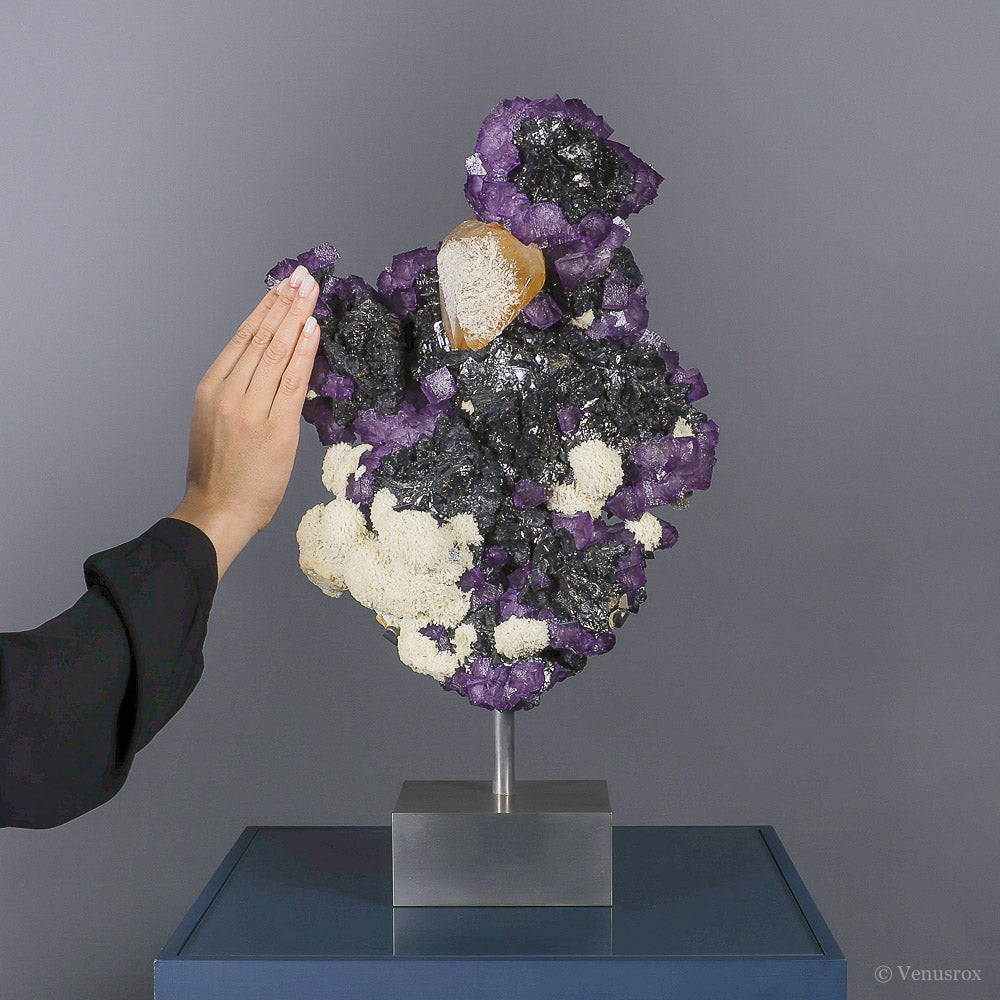
32.2cm x 43.5cm x 13.5cm (12.7in x 17.1in x 5.3in)
NFS
Enquiries handled privately via WhatsApp or email
_____
Choose options
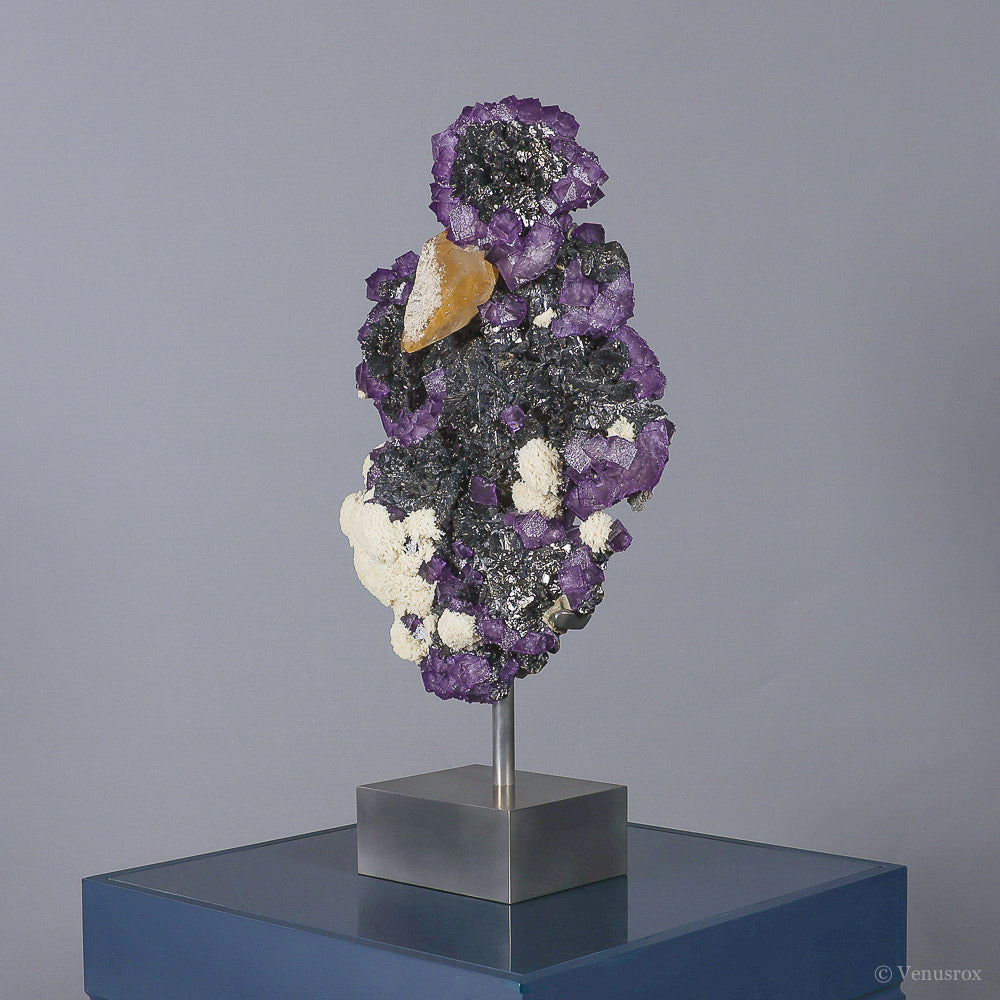
This extraordinary specimen represents the zenith of American mineral collecting. A dramatic sculptural composition featuring deep violet Fluorite cubes, honey-gold Calcite, and ivory Barite rosettes, all perched upon a lustrous matrix of brown/black Sphalerite. Few localities on Earth produce such chromatic and mineralogical complexity in a single specimen.
The Elmwood Mine in Smith County, Tennessee, remains legendary among collectors for yielding world-class examples of this precise mineral association. Operating as a commercial zinc mine since 1969, Elmwood's hydrothermal ore bodies formed within Ordovician-age limestone approximately 450 million years ago, when metal-rich fluids migrated through fractures and cavities in the carbonate bedrock. The unique geochemistry of these fluids, combined with slow cooling rates and stable crystallisation conditions, produced specimens of exceptional size, clarity, and aesthetic arrangement.
The ‘crown-like’ Fluorite crystals display the saturated purple coloration characteristic of Elmwood's finest production, their cubic habit and glassy luster contrasting dramatically against the metallic adamantine faces of the Sphalerite substrate. The Calcite, a distinctive scalenohedral form with elongated, pointed terminations, emerges in warm golden tones, while cream barites provide textural counterpoint with their intricate crystalline rosettes.
Sphalerite, a Zinc Sulfide mineral and the mine's primary ore, serves here as both matrix and aesthetic anchor — its near-black coloration intensifying the chromatic impact of the Fluorite and Calcite. Specimens preserving this full four-mineral association with such balance and integrity are increasingly rare, as Elmwood production has declined significantly in recent decades.
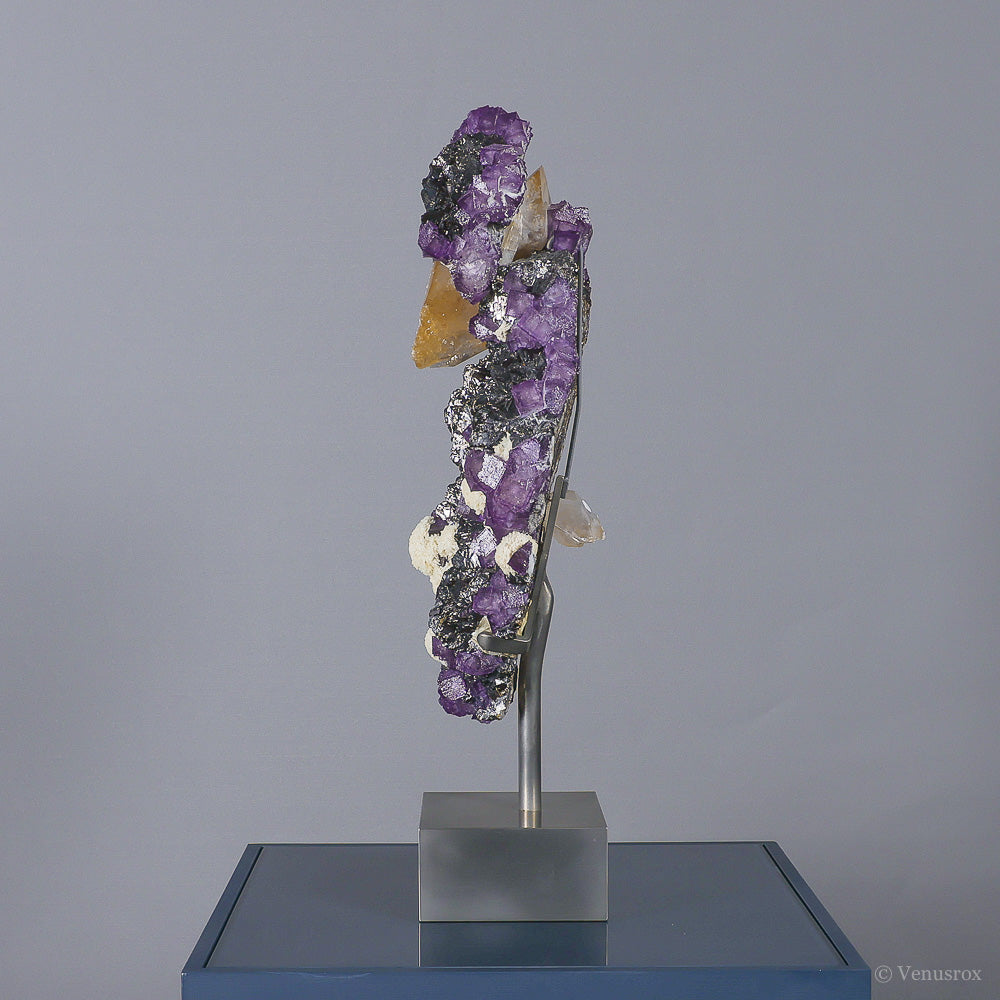
Presented upon a bespoke stand, this piece transcends specimen status, a geological masterwork of form, colour, and deep-earth alchemy.
FLUORITE
Fluorite helps one to work through life’s challenges with confidence and ease. It assists in clearing one’s energy fields and bringing clarity, helping one to stay focused and motivated on the task or gaol.
It teaches one that there are no mistakes in life, only learning experiences.
Fluorite also brings strength and determination, assisting with decision making, so one can choose a direction and take action to achieve one’s goals and dreams.
STELLAR BEAM CALCITE
Stellar Beam Calcite is an increasingly powerful stone, helping one clear resistance to claiming one’s full power. It can fill one’s aura with high frequency light, and it can clear one’s aura of negative thoughts, patterns or habits.
It also offers powerful protection on a psychic level. It is very much a stone that is becoming extremely important and relevant in our spiritual evolution. A stone of the moment.
BARITE
Barite is a wonderful stone to help one align one’s energies to energies of the highest vibration and realise one’s highest purpose. It helps one get fully into one’s power by clearing those energies around us that no longer serve any purpose. It helps one overcome any fear of change that may exist that is preventing one from fulfilling one’s true purpose.
SPHALERITE
Sphalerite is a wonderful grounding stone. It enhances one’s physical energy by helping one draw energy and vitality up from the earth, while releasing excessive energy. It increases one’s strength and courage, and it encourages us to take care of our physical body. It is an excellent stone for regulating the flow of energy in one’s body. Making for greater success in manifestation, clearer thinking and more willpower.
Description
This extraordinary specimen represents the zenith of American mineral collecting. A dramatic sculptural composition featuring deep violet Fluorite cubes, honey-gold Calcite, and ivory Barite rosettes, all perched upon a lustrous matrix of brown/black Sphalerite. Few localities on Earth produce such chromatic and mineralogical complexity in a single specimen.
The Elmwood Mine in Smith County, Tennessee, remains legendary among collectors for yielding world-class examples of this precise mineral association. Operating as a commercial zinc mine since 1969, Elmwood's hydrothermal ore bodies formed within Ordovician-age limestone approximately 450 million years ago, when metal-rich fluids migrated through fractures and cavities in the carbonate bedrock. The unique geochemistry of these fluids, combined with slow cooling rates and stable crystallisation conditions, produced specimens of exceptional size, clarity, and aesthetic arrangement.
The ‘crown-like’ Fluorite crystals display the saturated purple coloration characteristic of Elmwood's finest production, their cubic habit and glassy luster contrasting dramatically against the metallic adamantine faces of the Sphalerite substrate. The Calcite, a distinctive scalenohedral form with elongated, pointed terminations, emerges in warm golden tones, while cream barites provide textural counterpoint with their intricate crystalline rosettes.
Sphalerite, a Zinc Sulfide mineral and the mine's primary ore, serves here as both matrix and aesthetic anchor — its near-black coloration intensifying the chromatic impact of the Fluorite and Calcite. Specimens preserving this full four-mineral association with such balance and integrity are increasingly rare, as Elmwood production has declined significantly in recent decades.
Presented upon a bespoke stand, this piece transcends specimen status, a geological masterwork of form, colour, and deep-earth alchemy.
Metaphysical
FLUORITE
Fluorite helps one to work through life’s challenges with confidence and ease. It assists in clearing one’s energy fields and bringing clarity, helping one to stay focused and motivated on the task or gaol.
It teaches one that there are no mistakes in life, only learning experiences.
Fluorite also brings strength and determination, assisting with decision making, so one can choose a direction and take action to achieve one’s goals and dreams.
STELLAR BEAM CALCITE
Stellar Beam Calcite is an increasingly powerful stone, helping one clear resistance to claiming one’s full power. It can fill one’s aura with high frequency light, and it can clear one’s aura of negative thoughts, patterns or habits.
It also offers powerful protection on a psychic level. It is very much a stone that is becoming extremely important and relevant in our spiritual evolution. A stone of the moment.
BARITE
Barite is a wonderful stone to help one align one’s energies to energies of the highest vibration and realise one’s highest purpose. It helps one get fully into one’s power by clearing those energies around us that no longer serve any purpose. It helps one overcome any fear of change that may exist that is preventing one from fulfilling one’s true purpose.
SPHALERITE
Sphalerite is a wonderful grounding stone. It enhances one’s physical energy by helping one draw energy and vitality up from the earth, while releasing excessive energy. It increases one’s strength and courage, and it encourages us to take care of our physical body. It is an excellent stone for regulating the flow of energy in one’s body. Making for greater success in manifestation, clearer thinking and more willpower.