
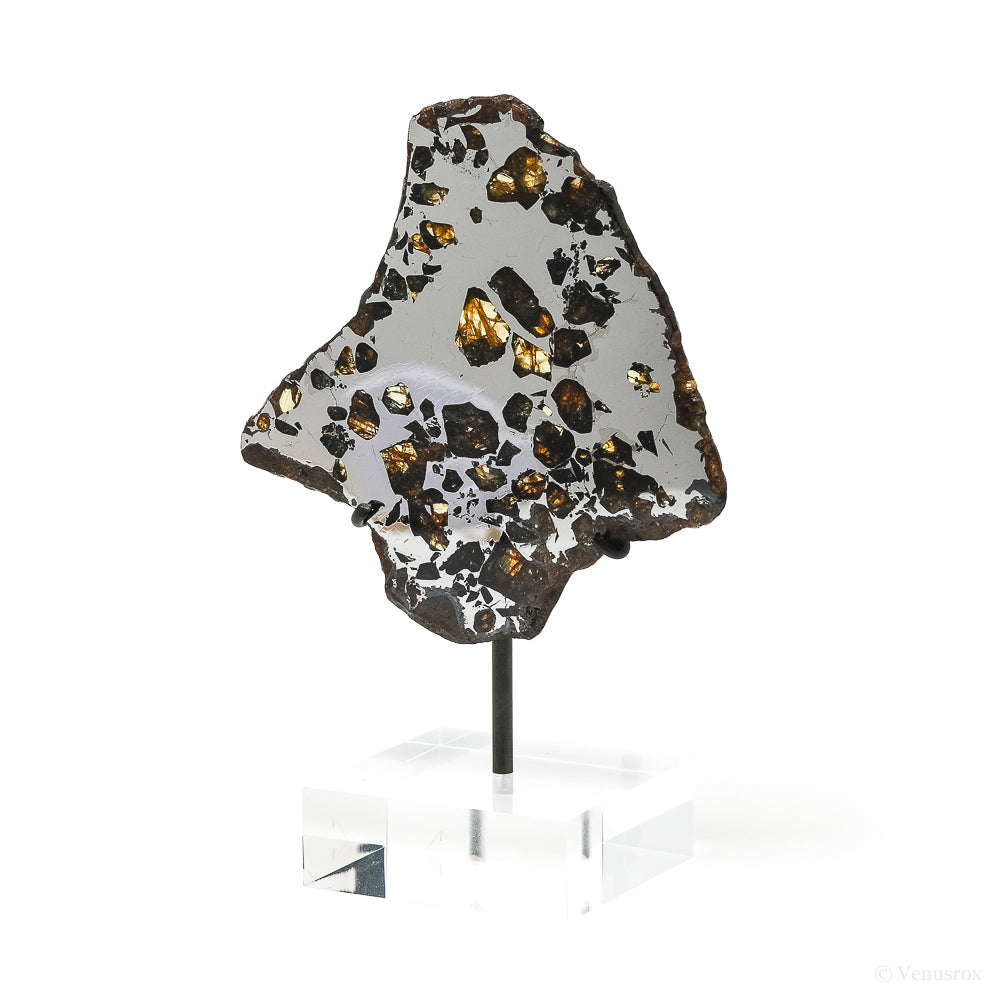
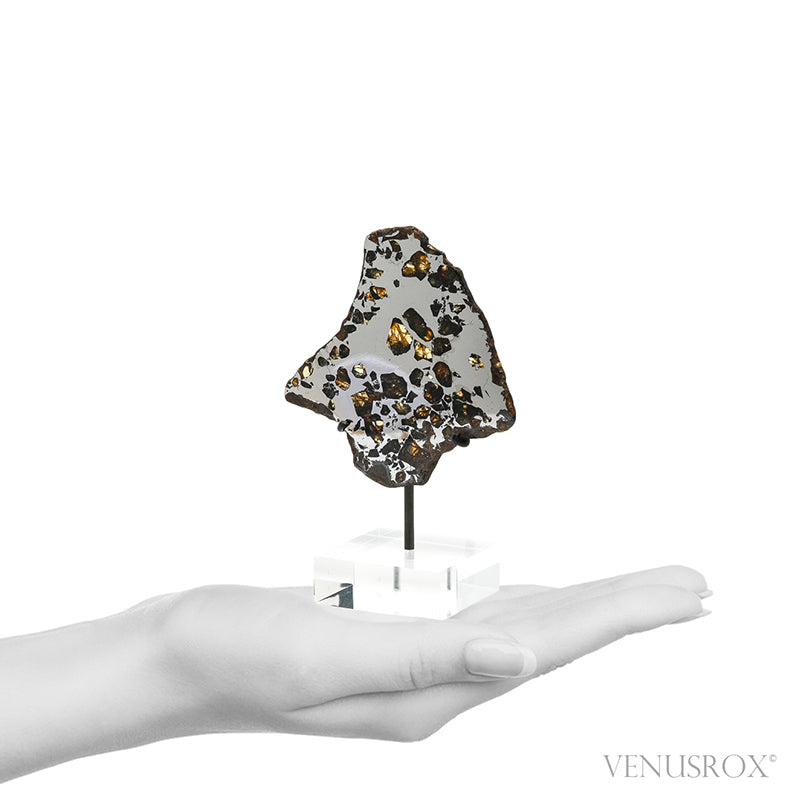
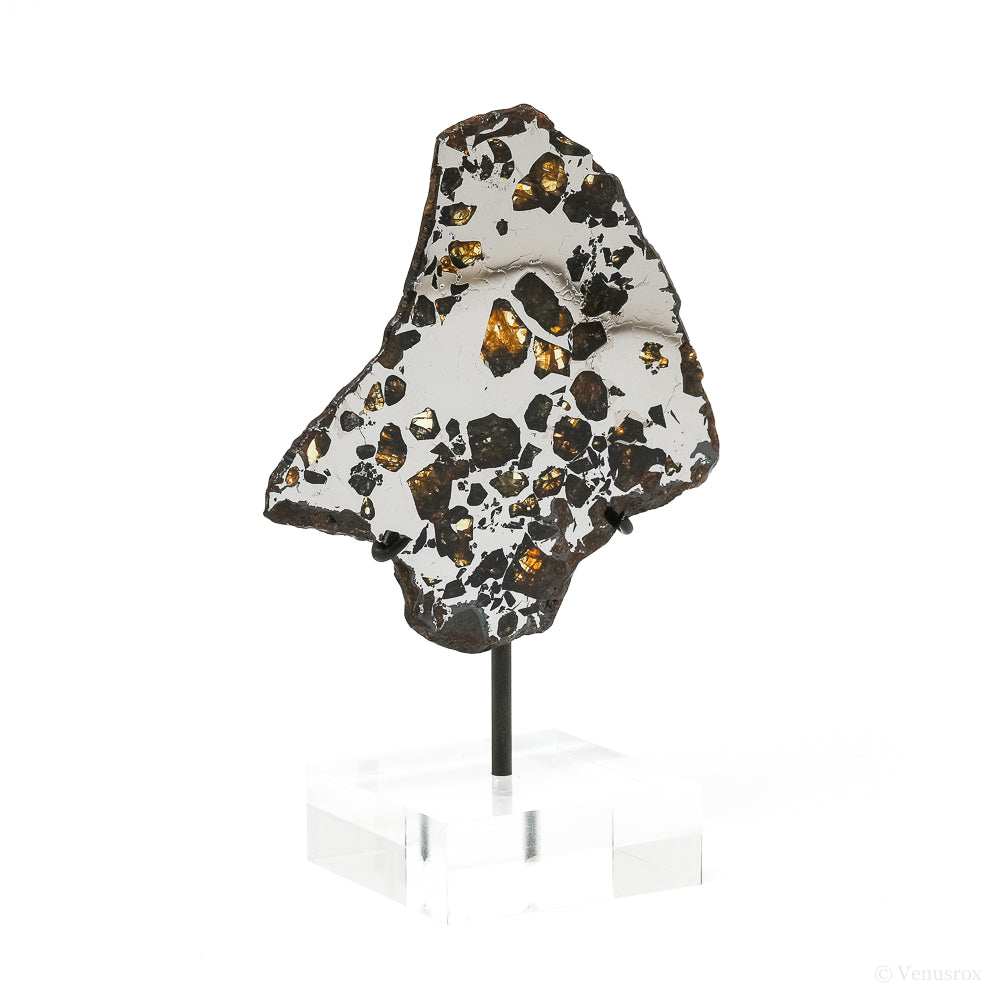
METEORITE (SEYMCHAN PALLASITE) POLISHED SLICE
ORIGIN:
Product Details
- CRYSTAL/MINERAL
- SEYMCHAN PALLASITE METEORITE
- location
- Hekandue River, Jasačnaja, Magadan District, Russia
- SKU
- 142613
- DIMENSIONS
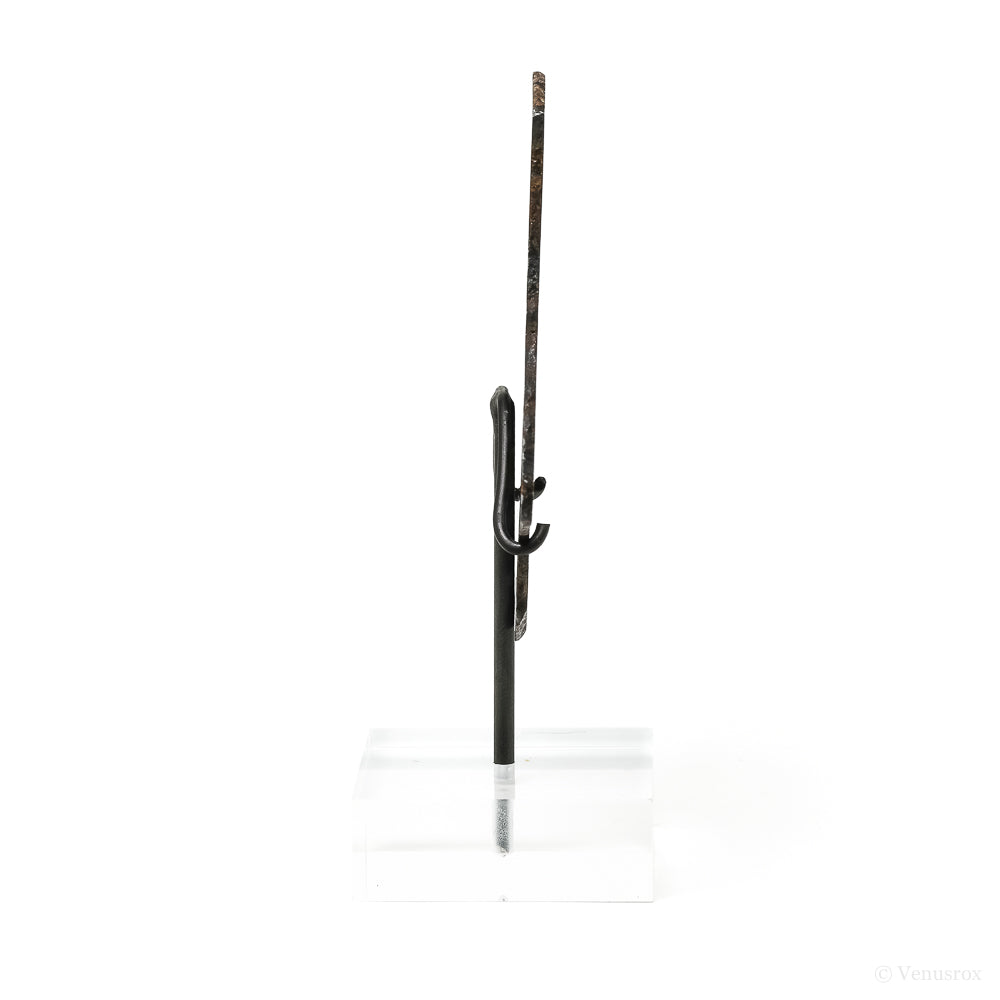
- 12.3cm x 8.1cm x 4.4cm (4.8in x 3.2in x 1.7in) including stand
- GEOLOGICAL FORMATION
- Pallasites are among the rarest Meteorites. They are Stony-Iron Meteorites in which crystals of Olivine are held in a matrix of Nickel-Iron metal. The group is named for Peter Simon Pallas, the naturalist who described the Krasnojarsk mass in the 18th century. Seymchan belongs to the group, and this slice is the metal-rich end of it.
The face is dominated by Nickel-Iron, an alloy of Iron and Nickel that is silver-grey where polished and etched, and far softer than the silicates it holds. Etching has brought out its internal structure. Rounded cells outlined in fine, bright seams cover most of the surface, and towards the centre, straight parallel lamellae cross in the angular, interlocking arrangement of the Widmanstätten pattern. This pattern forms only in metal that has cooled very slowly, over millions of years, inside a large body in space, and it cannot be reproduced in a laboratory or a foundry.
Olivine is the other component. It is a Magnesium-Iron Silicate, (Mg,Fe)₂SiO₄, the same mineral that is cut as the gemstone Peridot, and it crystallises in the orthorhombic system with a hardness of 6.5–7 on the Mohs scale. In this slice the crystals are dark, almost black, and opaque, set into the metal as rounded and angular inclusions.
The materials are believed to come from the interior of a differentiated asteroid. Early in the history of the Solar System, some asteroids melted and separated into a metallic core and a Silicate mantle. Pallasites preserve a mixture of the two, Olivine from the mantle and metal from the core. Whether that mixing happened at the boundary between core and mantle or through impact is still debated. Either way, the material formed about 4.5 billion years ago. Seymchan was found in the Magadan region of north-eastern Russia and is classified as a main-group Pallasite.
Terrestrial weathering has oxidised the outer margin to a rusty brown, which is typical of a meteorite that has spent time on the ground. The natural exterior has been left in place, and the cut face shows the interior.
Choose options
METEORITE (SEYMCHAN PALLASITE) POLISHED SLICE
Sale priceAED 15,000.00