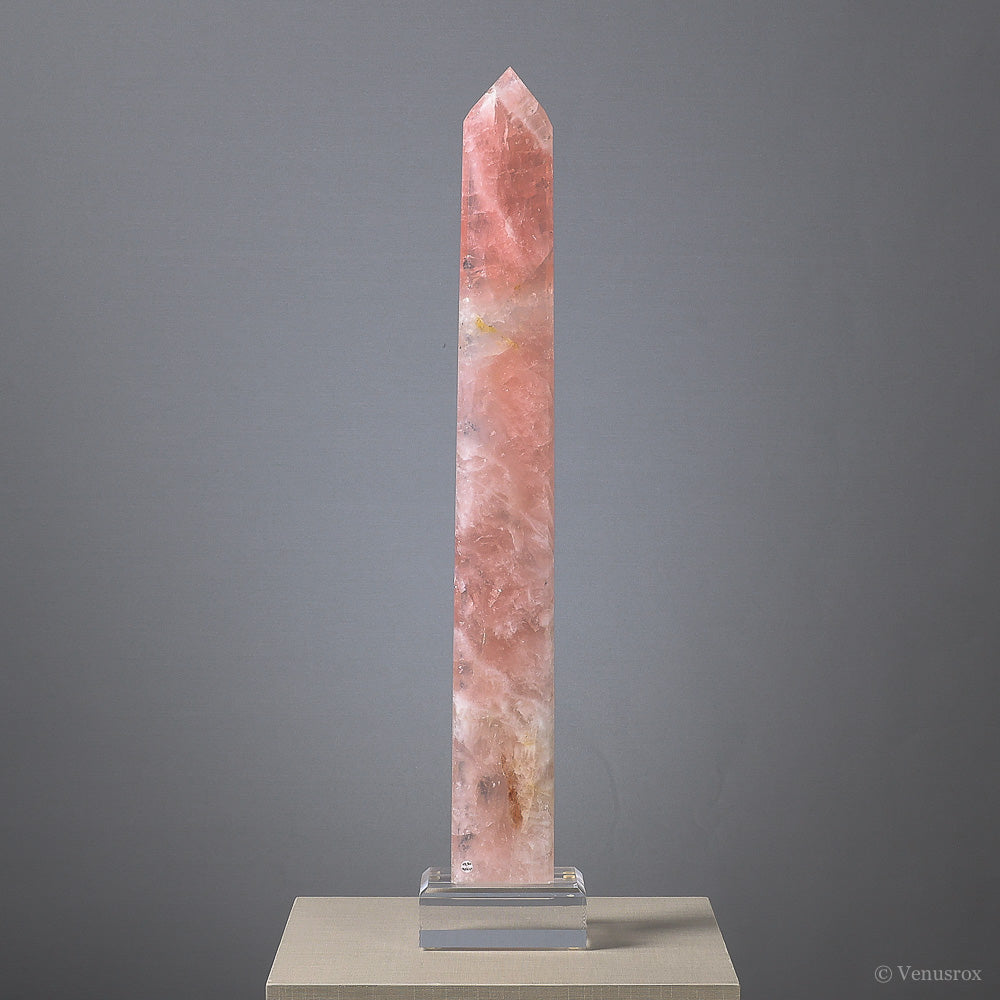
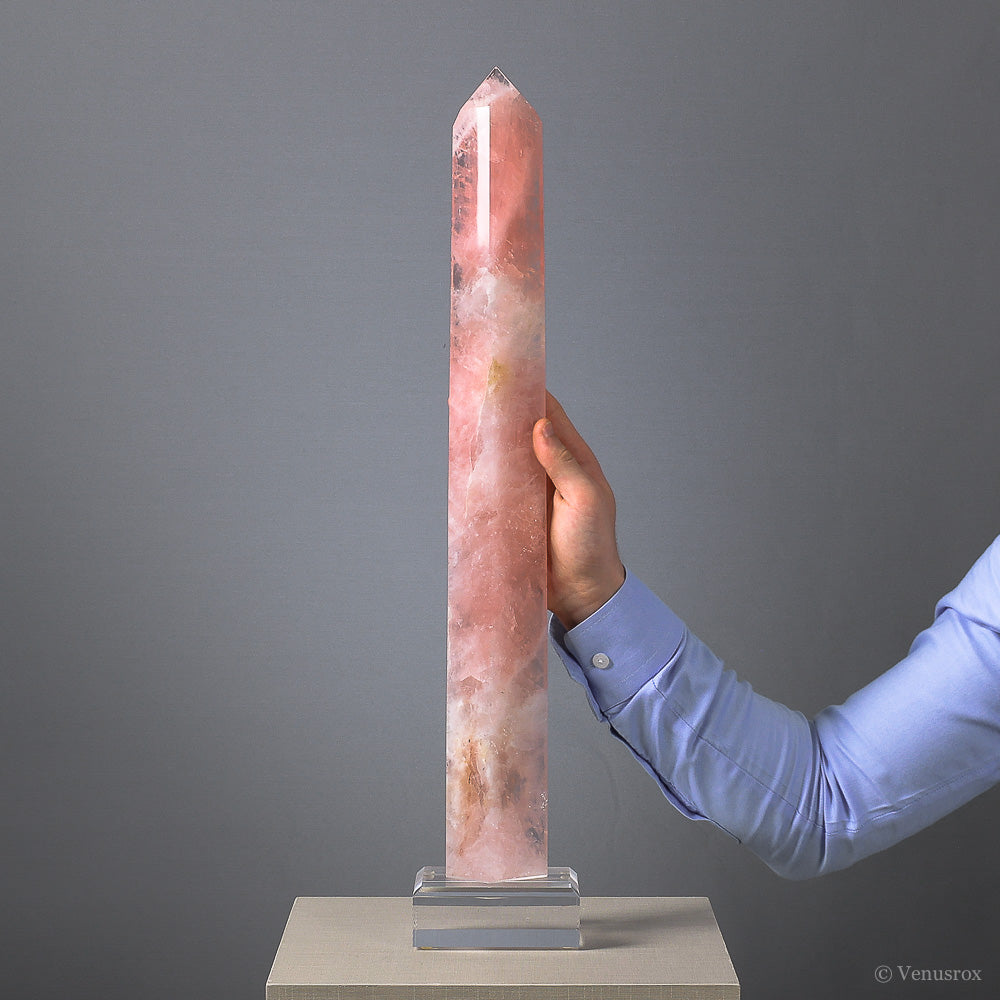
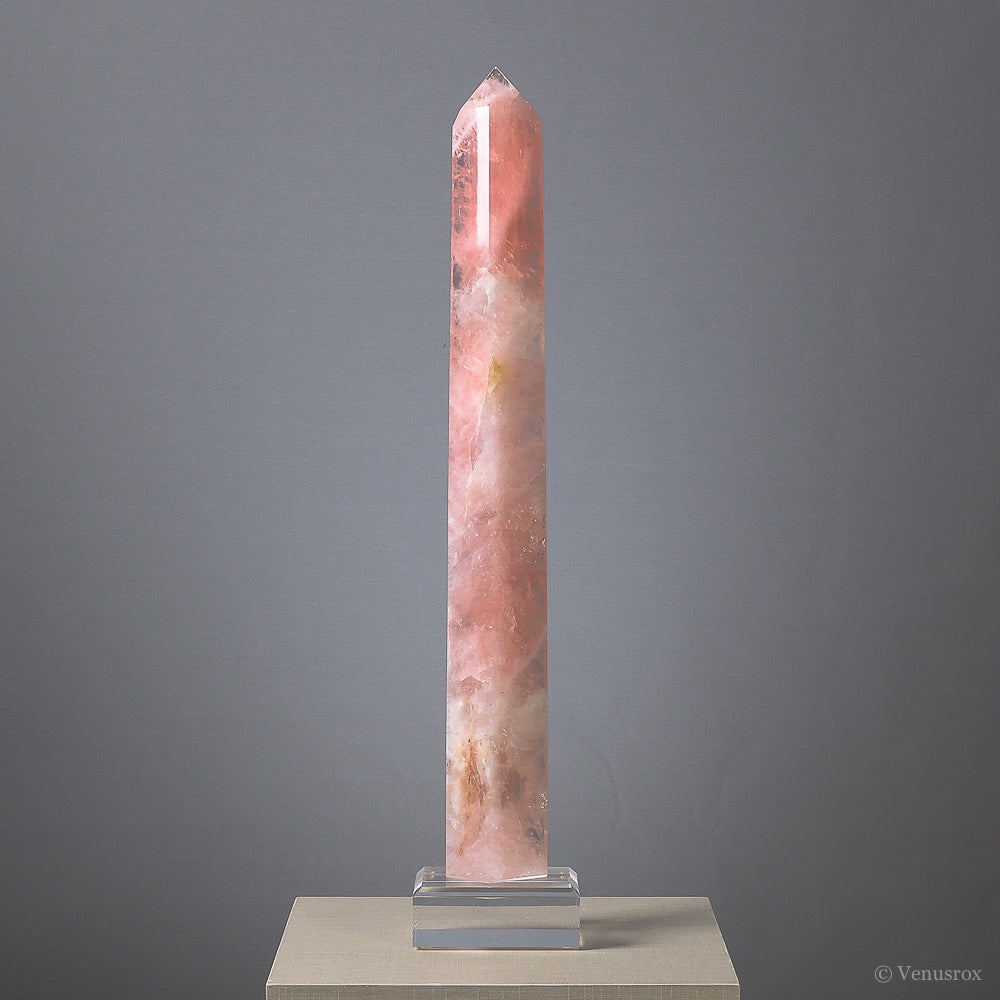
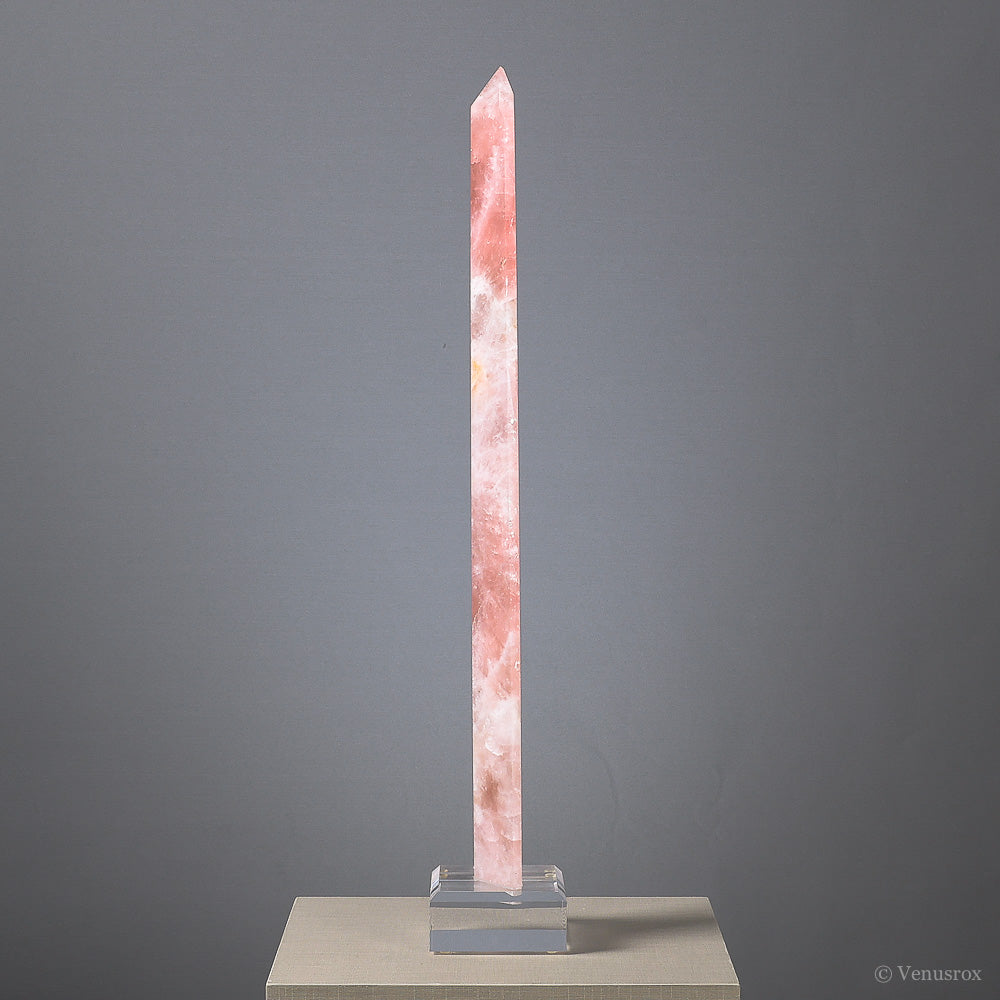
This elegant obelisk presents Rose Quartz as geological watercolour, soft washes of coral pink deepening to dusky rose, interrupted by milky white clouds and subtle amber accents that drift through the polished form like pigment suspended in glass. The tall, attenuated proportions emphasise verticality, drawing the eye upward through shifting zones of colour and translucency to the crisp faceted termination.
The chromatic variation displayed in this specimen reveals the complex nature of Rose Quartz formation. The pink coloration derives from microscopic fibrous inclusions, likely Dumortierite or related Borosilicate minerals, whose uneven distribution creates the banded, atmospheric quality visible here. Zones of deeper saturation indicate higher inclusion density, while clearer passages represent areas where the silicon dioxide crystallised with fewer colour-causing particles. The warm ochre accents suggest trace iron oxide, adding further painterly dimension.
Brazil's Minas Gerais pegmatites produce Rose Quartz across a spectrum of clarity and colour intensity. Specimens displaying this degree of internal variation, rather than uniform colouration, possess unique character, each piece an unrepeatable study in mineral aesthetics. The interplay of transparent, translucent, and near-opaque passages creates genuine visual depth, the stone revealing different aspects as light conditions shift.
The obelisk form, carved from massive rose quartz rough, references the hexagonal crystal system of the quartz family. Though Rose Quartz rarely forms visible crystal terminations naturally, the faceted point pays homage to its crystallographic heritage.
Presented upon a minimal acrylic base, this piece stands as a quiet monument to chromatic subtlety.